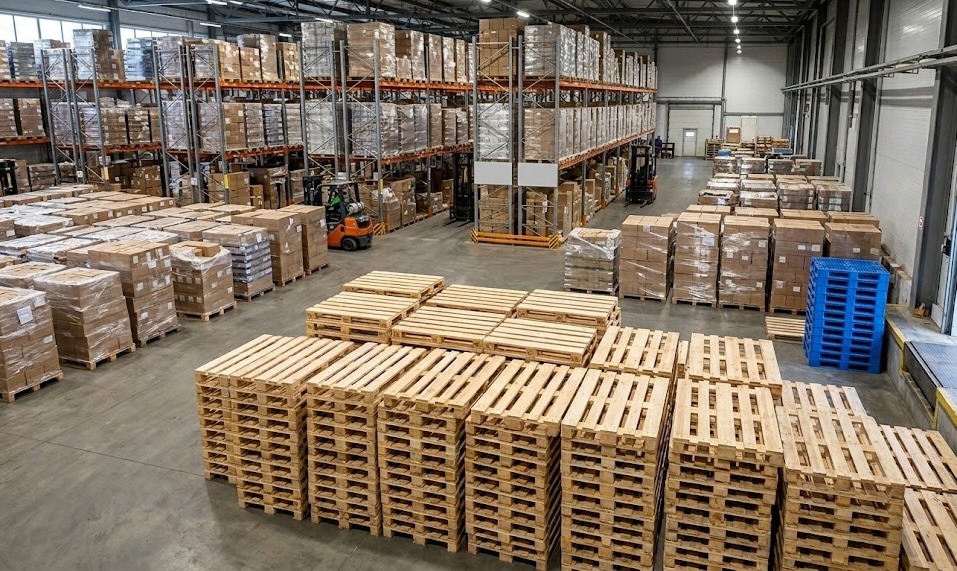
Sustainability Mission
Every used pallet we handle is a step toward a greener future. Here's how we make it happen.
Join Our Green Initiative
A Zero-Waste Vision for Pallets
At Raleigh EcoPallet, sustainability is not a department or a marketing initiative — it is the fundamental reason our company exists. We were founded on the conviction that the millions of pallets discarded every year represent a massive, unnecessary waste of natural resources. Our mission is to capture that waste and transform it into value: value for businesses through cost savings, and value for the environment through resource conservation.
We measure our success not just by revenue, but by the environmental impact we create. Every pallet we keep in circulation is a tree that stays standing, carbon that stays out of the atmosphere, and space that is not consumed in a landfill. Our goal is to prove that environmental responsibility and business profitability go hand in hand.
The Numbers Speak
Pallets Recycled Annually
Waste Diverted from Landfills
Trees Saved
Material Recovery Rate
CO2 Emissions Prevented
Water Conserved
Energy Saved
Pallets Sent to Landfill
Our Four Sustainability Pillars
Reuse
Our primary goal is to keep pallets in circulation as long as possible. Every used pallet we sell has been inspected, repaired if needed, and graded for quality. A single pallet can be reused 15-20 times before it reaches end of life.
The reuse pillar is the most impactful part of our sustainability strategy. When a business buys a used pallet instead of a new one, the environmental benefit is immediate and quantifiable. No trees were harvested, no energy was consumed in manufacturing, no chemicals were used for treatment, and no transportation emissions were generated from factory to warehouse. We estimate that every used pallet sold saves approximately 3.5 cubic feet of lumber and 31 kg of CO2 emissions. At our current volume, that amounts to over 175,000 cubic feet of lumber and 1,550 tons of CO2 annually.
Repair
When a pallet sustains damage, we do not discard it. Our repair team replaces broken boards, reinforces weak points, and restores pallets to working condition. This extends the average pallet lifespan by 3.5 times.
Our repair program is where skilled hands make the biggest difference. Many pallets that appear damaged beyond use can be restored with relatively simple repairs — replacing one or two broken deck boards, hammering down protruding nails, or reinforcing a cracked stringer. Our repair team can typically restore a pallet in under 10 minutes at a cost of $1 to $4, compared to $15 to $25 for a brand-new replacement. This extends each pallet life by an average of 3.5 times its expected single-use duration.
Recycle
When a pallet truly reaches the end of its life, we break it down into raw materials. Wood becomes mulch, animal bedding, or biomass fuel. Hardware is separated for metal recycling. Nothing goes to waste.
Even when a pallet can no longer be repaired or reused, its materials still have value. Our recycling process breaks down end-of-life pallets into their component materials. Clean wood is ground into landscape mulch, animal bedding, or wood chips for biomass energy production. Metal nails and fasteners are magnetically separated and sent to metal recycling facilities. Treated or contaminated wood is handled according to environmental regulations. The result is a true zero-waste process where 95% of incoming material finds a second life in some form.
Reduce
We help businesses reduce their overall pallet consumption through better pallet management practices, right-sizing recommendations, and programs that optimize pallet utilization across their supply chains.
The most sustainable pallet is one that never needs to be produced at all. We work with our customers to optimize their pallet usage through several strategies: right-sizing (ensuring they are not using larger pallets than needed), rotation programs (keeping pallets moving efficiently rather than sitting idle), proper handling training (reducing damage and extending pallet life), and supply chain analysis to identify opportunities for pallet pooling or sharing among compatible businesses in the same area.
Our Recycling Process
Every pallet that enters our facility follows a carefully designed process that maximizes reuse and minimizes waste. Here is exactly what happens.
Intake & Initial Sort
Pallets arrive from pickups and drop-offs. They are immediately sorted into three categories: likely resalable, repairable, and recycling candidates. This initial triage ensures efficient processing throughout the rest of the pipeline.
Detailed Inspection
Each pallet undergoes our six-step inspection: visual check, structural testing, dimensional verification, fastener inspection, contamination screening, and grade assignment. Pallets are categorized as Grade A, B, C, or directed to repair or recycling.
Repair Station
Pallets with repairable damage move to our repair workshop. Skilled workers replace broken boards, re-secure loose nails, and reinforce weakened stringers. Repaired pallets are re-inspected and assigned the appropriate grade.
Graded Storage
Inspected and repaired pallets are organized by size and grade in our storage yard. This organization allows us to fulfill customer orders quickly and accurately.
Deconstruction
Pallets that cannot be repaired economically are deconstructed. Reusable boards are saved for repair stock. Remaining wood and hardware are separated for recycling.
Material Processing
Wood goes through grinding to become mulch, animal bedding, or biomass fuel. Metal is magnetically separated and baled for recycling. The result: zero usable material wasted.
Carbon Offset Calculations
Every used pallet sold instead of a new one manufactured represents a measurable reduction in carbon emissions. Here is how the math works.
CO2 per new pallet manufactured
CO2 for reusing an existing pallet
CO2 saved per pallet reused
Annual Carbon Impact of Raleigh EcoPallet
To put that in perspective, 1,550 tons of CO2 is equivalent to taking approximately 335 passenger cars off the road for a year, or the carbon absorbed by about 25,000 tree seedlings grown for 10 years. These are not theoretical numbers — they represent the actual impact of the pallets we processed in the past year.
Trees Saved Through Pallet Reuse
Manufacturing a new standard pallet requires approximately 10 to 13 board feet of lumber. A typical tree yields about 500 board feet. By our calculations, every 40 to 50 pallets we keep in circulation saves one tree from being harvested.
Trees Saved This Year
Based on our annual processing volume of 50,000+ pallets, we estimate that over 1,200 trees were preserved because businesses chose used pallets from Raleigh EcoPallet instead of buying new ones.
Forest Area Preserved
1,200 trees represents approximately 6 acres of harvestable forest that remained standing because of our used pallet operations. That is 6 acres of carbon absorption, wildlife habitat, and natural beauty preserved.
Trees Saved Lifetime
Since our founding in 2018, we estimate that our operations have cumulatively saved over 4,500 trees from harvesting. That impact grows every year as our volume increases.
Water Conservation
Water consumption is an often-overlooked environmental cost of new pallet production. Manufacturing a single new wooden pallet requires water at multiple stages: growing the trees (irrigation), processing the lumber (sawmill operations), treating the wood (heat treatment or chemical treatment), and cleaning equipment. Estimates suggest that producing one new pallet requires approximately 48 gallons of water across its full production lifecycle.
Water used per new pallet
Water saved annually by our operation
By reusing 50,000+ pallets annually, Raleigh EcoPallet prevents the need for approximately 2.4 million gallons of water that would have been consumed manufacturing new replacements. That is enough water to fill nearly 4 Olympic-sized swimming pools or supply drinking water to over 20 households for an entire year.
Why Used Pallets Matter for the Environment
Reduced Deforestation
The US produces approximately 500 million new pallets each year, consuming billions of board feet of lumber. By choosing used pallets, you directly reduce demand for new timber harvesting.
Lower Carbon Footprint
Manufacturing a new pallet produces about 31 kg of CO2. Reusing a pallet produces nearly zero. Over thousands of pallets, the carbon savings are enormous.
Landfill Diversion
Pallets make up about 10% of landfill waste in the United States. Our recycling program ensures that zero pallets from our facility end up in a landfill.
Resource Conservation
Beyond wood, new pallet production requires water, energy, and chemicals for treatment. Reusing pallets conserves all of these resources.
Certifications & Partnerships
Environmental Certifications
- ISPM-15 Compliance
Our heat treatment capabilities meet international standards for wood packaging materials, ensuring proper phytosanitary treatment.
- Zero-Waste Operations
95% material recovery rate with a commitment to reaching 97% by 2026. All materials are either reused, repaired, recycled, or converted to energy.
- NWPCA Standards
Our grading and inspection processes align with National Wooden Pallet and Container Association quality standards.
Environmental Partnerships
- Local Recycling Facilities
Partnerships with North Carolina recycling processors who handle our end-of-life wood and metal materials responsibly.
- Community Environmental Groups
Collaboration with Triangle-area environmental organizations on education, awareness, and sustainability initiatives.
- Mulch & Biomass Producers
Relationships with local producers who convert our recycled wood into landscape mulch, animal bedding, and biomass energy.
How Your Business Can Make a Difference
Every business that touches pallets has an opportunity to reduce its environmental footprint. Here are practical steps you can take today.
Switch to used pallets for non-critical applications
Grade B used pallets perform identically to new pallets for general warehousing, domestic shipping, and storage. Start by converting even a portion of your pallet purchases to used — the savings and environmental benefits add up quickly.
Implement a pallet return or buyback program
Instead of discarding pallets after receiving shipments, arrange for a pallet company like Raleigh EcoPallet to pick them up. You may receive payment for pallets in good condition, and all pallets will be properly recycled instead of landfilled.
Train your team on proper pallet handling
A significant percentage of pallet damage is caused by improper forklift handling, incorrect stacking, and overloading. Training your team to handle pallets properly extends their life and reduces your replacement needs.
Right-size your pallet usage
Many businesses use the same pallet size for everything out of habit. Evaluate whether smaller pallets could work for lighter loads — this reduces lumber consumption, shipping weight, and cost.
Choose a supplier with strong environmental practices
Not all used pallet companies handle recycling responsibly. Partner with a supplier like Raleigh EcoPallet that has documented environmental practices, high recovery rates, and a genuine commitment to zero waste.
Track and report your sustainability metrics
Measure how many used pallets you purchase, how many you return for recycling, and the estimated environmental savings. These numbers can support corporate sustainability reporting and demonstrate real commitment to stakeholders.
The Raleigh EcoPallet Sustainability Commitment
Request Our Sustainability Report
Need detailed environmental impact data for your corporate sustainability reporting? We can provide documentation of pallets processed, materials recovered, estimated carbon savings, and more. Contact us to request our latest sustainability metrics.
"Partnering with Raleigh EcoPallet for our pallet recycling program has been a win on every front. We stopped paying disposal fees, started receiving revenue for our surplus pallets, and our sustainability team can now report real, quantified environmental impact data. It is the kind of partnership where everyone benefits."
Sustainability Director
Triangle-Area Manufacturing Company
Join Our Sustainability Mission
Whether you want to buy used pallets, set up a recycling program, or learn more about how your business can reduce its pallet-related environmental impact, we are here to help.